Minimally Invasive Spine Surgery
1 Hoag Drive, Newport Beach, CA 92658
(949) 764-1411
Looking for Minimally Invasive Spinal Surgery?
Our comprehensive team of specialists, physical therapists and spinal surgeons put patient-focused care at the forefront to provide the best quality care for the neck and back.
We’re dedicated to helping patients come back strong from spinal issues, utilizing next-generation technological advances, conservative approaches and the latest and most effective minimally invasive procedures. From spinal fusion to ending the pain of a herniated disc, for minimally invasive spinal surgery contact the Spine Institute today at (949) 764-1411.
Read on to learn about minimally invasive spinal surgery, including the specific types and conditions that can be treated and the many benefits of utilizing less-invasive techniques.
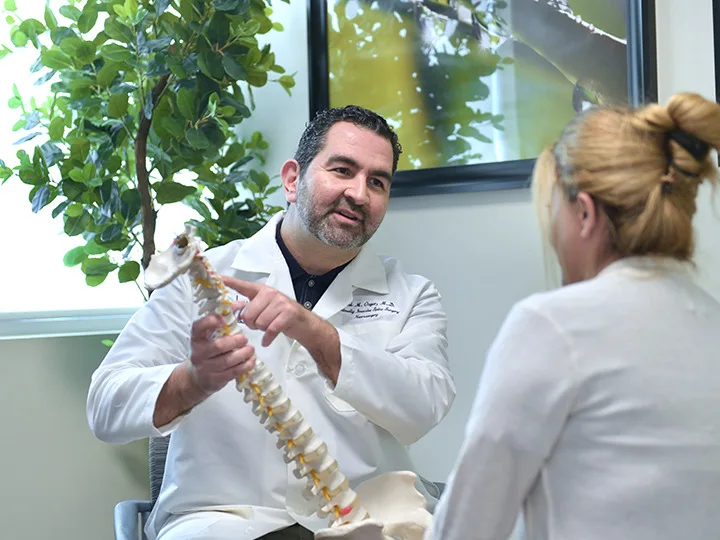
What is Minimally Invasive Spinal Surgery?
Minimally invasive spinal surgery is a type of surgery that uses short incisions, insertable cameras and small, specialized instruments to access and correct problems with the spine, including the vertebral column, spinal discs and surrounding soft tissue.
Minimally invasive spine surgery is an alternative to traditional “open” surgery for the spine, which is often performed through a long incision through the skin. Potential benefits of minimally invasive spine surgery include less postoperative pain, faster recovery time and less visible scarring.
- Types of Surgery
- Conditions Treated
- Benefits
- Find a Specialist
Which Conditions Can Be Treated With Minimally Invasive Spine Surgery?
Spine decompression surgery
Decompression surgery refers to a group of procedures that aim to reduce pressure on the spinal cord or nerves by creating more space inside the spinal canal. Different types of decompression surgery include:
Laminectomy
In this procedure, a portion of the bony roof of the vertebra (the lamina) is removed to create more space for the spinal cord and nerves
Foraminotomy
During this procedure, the bony opening in a vertebra where a nerve root exits the spinal canal (the foramen) is enlarged to provide more space for the nerve
Discectomy
In this surgery, a herniated disc that's pressing on a nerve in the spine is partially or completely removed
Kyphoplasty
Kyphoplasty is a minimally invasive procedure used to stabilize compression fractures of the vertebrae and reduce the pain they can cause. These fractures are usually due to osteoporosis, a condition that gradually weakens bones in older people. In some cases, compression fractures can cause the vertebrae to collapse, resulting in a curve in the upper spine (a condition called kyphosis).
The kyphoplasty procedure is performed by making a short incision in the skin, then inserting a small balloon into a vertebra that has been damaged by a compression fracture. Once in place, the balloon is inflated, creating a cavity that is then filled with a special bone cement. Once cured, the cement stabilizes the vertebra, stabilizing the fracture and, in some cases, restoring a portion of the vertebral body's height.
Spinal Fusion
Spinal fusion is an operation that permanently joins two or more vertebrae through bone grafts or surgical implants. Spinal fusion is often used to improve the stability of the spine and address issues like compressed or herniated discs, spinal deformity, or spondylolisthesis, a condition in which one vertebra slips down over another. Learn more about spondylolisthesis from Hoag.
Anterior cervical discectomy and fusion (ACDF)
ACDF is a surgical procedure commonly used to treat cervical nerve root or spinal cord compression caused by herniated discs, degenerative changes, or spinal stenosis in the neck. The procedure involves removing a damaged disc, then using surgical hardware or bone grafts to fuse the vertebrae above and below the removed disc for stability and to create more room for spinal nerves.
Artificial disc replacement
This procedure uses minimally invasive techniques to replace a damaged, herniated, or degenerated spinal disc in the neck (cervical spine) or lower back (lumbar spine) with an artificial one. By removing the diseased disc and replacing it with an artificial implant, disc replacement may help relieve nerve compression while preserving motion at the treated spinal level. Artificial disc replacement is used to preserve a more natural range of motion than a rigid spinal fusion.