Our vision
To transform how cancer is detected and treated.
Scientists and physicians working together to advance cancer research and move discoveries toward patient care.
Our research community
A snapshot of the people and resources behind the laboratory.
Laboratory launched
Scientists and research professionals
Principal investigators
Shared cores: Genomics & Sequencing and Pathology & Tissue-Based Research
Clinically embedded research
Scientific discovery, connected to the care of patients.
Hoag’s Translational Lab is a clinically embedded research ecosystem where scientists, physicians, and healthcare innovators work together to solve meaningful clinical challenges.
Unlike traditional academic laboratories, our research is conducted within a leading private cancer center, creating a direct pathway from scientific discovery to clinical implementation.
Our purpose
The vision and mission guiding our work.
To transform how cancer is detected and treated.
Detect cancer at its earliest stages and develop next-generation therapeutics for patients.
Research priorities
Explore the questions connecting our four laboratories.
Exosomes and liquid biopsy with MALDI-TOF profiling, clonal hematopoiesis (CHIP), extracellular-vesicle RNA. Demeure Lab · Madan Lab
Explore early detectionCell competition, cellular fitness and tumor–microenvironment signaling. Gogna Lab · Madan Lab
Explore cell competitionLiving patient-derived tumors tested against drugs in Hoag’s cross-cancer Functional Precision Medicine BioCore. Gogna Lab
Explore functional precision medicineTumor suppressor biology and therapeutic vulnerabilities such as CtBP and mutant p53 in pancreatic, ovarian and other cancers. Grossman Lab
Explore drug discoveryOur investigators
Four principal investigators, one integrated mission.
Principal investigator
Grace E. Hoag Executive Medical Director Endowed Chair, Hoag Family Cancer Institute
Director, Therapeutic Innovation · Molecular Oncology & Therapeutic Discovery
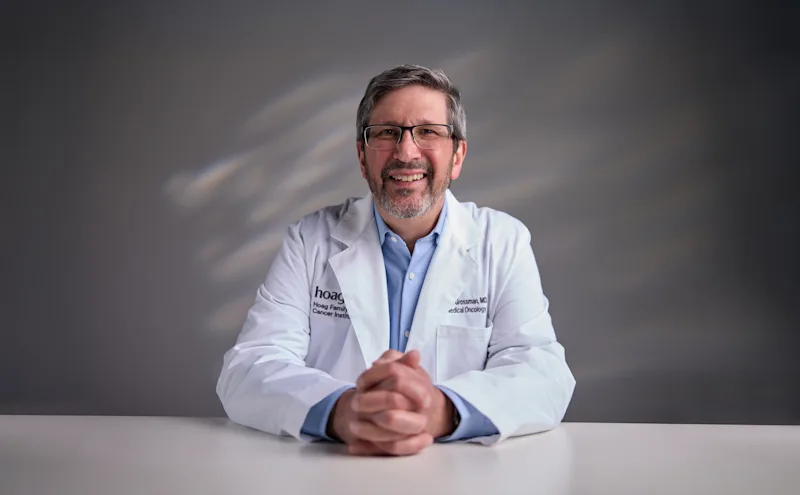
Grossman Laboratory
Integrating DNA, RNA, protein, and clinical data to develop a comprehensive understanding of tumor biology.
Cancer signaling and tumor suppressor biology
Therapeutic vulnerabilities (e.g., CtBP, mutant p53)
Mechanistic drug discovery and preclinical evaluation
Pancreatic, ovarian and other cancers
Principal investigator
Program Director, Hoag Precision Medicine Program · Otis Healy Family Endowed Chair in Applied Genomics
Director, Translational Oncology · Cancer Early Detection & Precision Medicine
Demeure Laboratory
Identifying molecular signatures that predict treatment response, prognosis, and disease progression.
Our primary goal is to identify novel biomarkers for diseases which lack existing means for early detection of disease development, including multiple sclerosis and various types of cancers. By identifying and validating such biomarkers, we hope to help patients receive treatment in a quicker and more effective manner.
Early cancer detection with MALDI-TOF. Healthy and cancerous cells use extracellular vesicles called exosomes to communicate. These nanoparticles carry RNA, DNA, and proteins; we are analyzing their contents to detect cancer early and monitor recurrence across cancer types.
Clonal hematopoiesis of indeterminate potential (CHIP). Blood cells acquire mutations over time that increase risk of certain cancers and cardiovascular disease; we are investigating how detecting them can support risk stratification and management of heart and liver disease.
Liquid biopsy and extracellular vesicle analysis
Early cancer detection and disease monitoring
Cancer genomics and molecular profiling
Precision medicine and clinical investigation
Principal investigator
Director of Translational Research, Hoag Family Cancer Institute
Cancer Cell Competition & Functional Precision Medicine
Gogna Laboratory
Applying translational discoveries to optimize trial design and patient selection.
Investigating cancer cell competition and tumor–host interactions to develop novel therapeutics and early-detection biomarkers, while using living patient-derived tumors to evaluate drug responses through Hoag’s cross-cancer Functional Precision Medicine BioCore.
Cancer cell competition and tumor evolution
Therapeutic development and drug-response testing
Functional Precision Medicine BioCore
Patient-derived tumor models and clinical translation
Principal investigator
Esha Madan, PhD
Principal Investigator and Group Leader, Cell Competition in Tumor Microenvironment Laboratory
Tumor Microenvironment & Early Cancer Detection
Madan Laboratory
Validating discoveries through diverse patient populations and advanced informatics.
Investigating how cancer cells interact with and reprogram surrounding healthy tissues, and translating discoveries in cellular fitness, tumor–microenvironment signaling, and extracellular-vesicle RNA biology into innovative approaches for early cancer detection and therapeutic development.
Cancer–microenvironment interactions
Cell competition and tumor–host fitness
Extracellular vesicles and molecular biomarkers
Early detection and therapeutic approaches
Published research
Selected work by Hoag investigators, including research published before they joined Hoag.
Nature Medicine
Blood-based RNA biomarker for the early detection of ovarian cancer
Hoag authors: Steven R. Grossman; Rajan Gogna; Esha Madan · 2026
Nature Medicine
Liquid biopsy for early detection of pancreatic ductal adenocarcinoma
Hoag authors: Sourat Darabi; Michael J. Demeure; Carlos Becerra · 2026
Nature Biotechnology
Hoag authors: Esha Madan; Steven R. Grossman; Rajan Gogna · 2025 (online 2024)
Oncogenesis
Hoag author: Steven R. Grossman · 2023
Cancer Research
Cell Competition in Carcinogenesis
Hoag authors: Esha Madan; Rajan Gogna · 2022
The EMBO Journal
Cell competition in intratumoral and tumor microenvironment interactions
Hoag authors: Steven R. Grossman; Esha Madan; Rajan Gogna · 2021
Nature
Flower isoforms promote competitive growth in cancer
Hoag authors: Esha Madan; Rajan Gogna · 2019
From discovery to care
Follow the path from a clinical question to research and clinical translation.
1
Fundamental research to understand cancer biology, identify biomarkers, and uncover therapeutic vulnerabilities.
2
Molecular, cellular, and functional studies using advanced models, including patient-derived tumor tissues.
3
Biomarker validation, therapeutic development, precision medicine approaches, and functional drug testing.
4
Collaboration with clinical teams to evaluate diagnostic and therapeutic strategies and advance discoveries toward clinical trials.
Research infrastructure
Shared capabilities supporting the work of all four laboratories.
Dr. Sourat Darabi Genomic sequencing, molecular profiling, and bioinformatics across all laboratories.
Dr. David R. Braxton Pathology expertise, tissue analysis, and molecular pathology integration across all laboratories.
Our team
Meet the team at Hoag’s Translational Research Laboratory.
Members of Hoag’s Translational Research Laboratory team.
Community philanthropy supports the laboratory’s growth. Early investment from Hoag Innovators launched the laboratory in 2023. Circle 1000 has committed fundraising support to its expansion, and the Clemons Family Clinical and Translational Research Endowment is helping fund expansion and recruitment.
Get involved
Find the right connection for your interest in research.
Connect with Hoag’s Clinical Research Office about research collaborations and clinical studies.
Contact Clinical Research