What is lung adenocarcinoma? Understanding the most common type of lung cancer
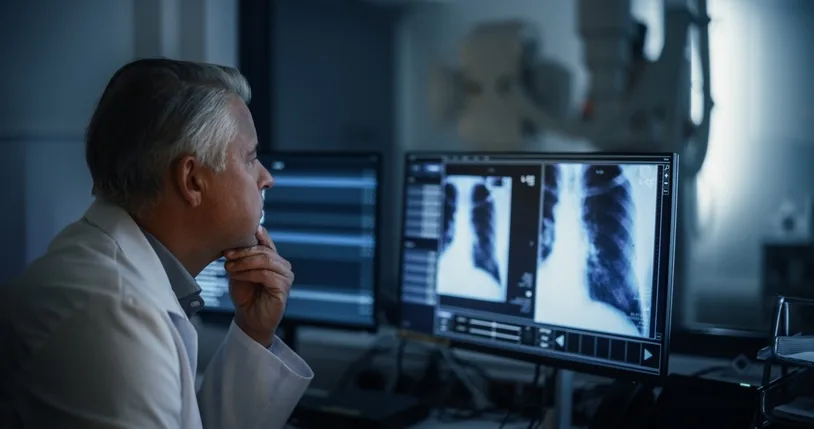
Recent news headlines have brought attention to a type of lung cancer that many people may not recognize by name: lung adenocarcinoma.
Accounting for approximately 40% of lung cancer cases, adenocarcinoma is the most common type of lung cancer. Although smoking is a major risk factor, it can also develop in people who have never smoked.
So, what exactly is lung adenocarcinoma, what are the risk factors, and what treatment options are available? Dr. Daryl Pearlstein, director of thoracic surgery and the lung cancer program at Hoag, explains what patients should know.
What is lung adenocarcinoma?
“Lung adenocarcinoma is the most common type of non-small cell lung cancer (NSCLC), which begins in glandular cells lining the airways that produce mucus, a substance that functions to clear the lungs,” Dr. Pearlstein says.
Adenocarcinoma, while always problematic, has a wide range of aggressiveness and can behave differently from person to person. Some tumors grow slowly over a long period of time, while others may grow and metastasize quickly. The stage at diagnosis, or how far the cancer has progressed, helps doctors determine the most appropriate treatment.
How is lung adenocarcinoma different from other lung cancers?
Lung cancer is generally divided into two main categories: non-small cell lung cancer and small cell lung cancer. Each type has different characteristics that help doctors determine the best approach to care.
The three main types of non-small cell lung cancer are:
Adenocarcinoma: Begins in glandular cells and often develops in the outer portions of the lungs. It is the most common type of lung cancer and can affect people who have never smoked.
Squamous cell carcinoma: Develops in the cells lining the larger airways. It is strongly associated with smoking and often begins near the center of the lungs.
Large cell carcinoma: A less common type that can develop in different areas of the lungs.
Small cell lung cancer is a separate category that generally grows and spreads more quickly than non-small cell lung cancer.
Where does lung adenocarcinoma develop?
“Lung adenocarcinoma most often develops in the outer areas of the lungs, near the small airways and air sacs called alveoli, although it can occur near more central larger airways as well” Dr. Pearlstein says.
What are the risk factors for lung adenocarcinoma?
Cigarette smoking is the leading risk factor for lung cancer. However, people who have never smoked can also develop lung adenocarcinoma. In fact, it is the most common type of lung cancer among people who have never smoked.
Other factors that may increase the risk include:
Exposure to radon gas
Secondhand smoke
Air pollution
Certain workplace substances
A family history of lung cancer
Researchers have also identified genetic changes in some lung tumors that can contribute to cancer growth. These changes can occur in people with or without a history of smoking.
The important thing to remember is that lung cancer can affect people with different health and smoking histories. Not smoking significantly lowers the risk, but it does not eliminate it.
What are the symptoms?
Lung adenocarcinoma usually does not cause noticeable symptoms in its early stages. When symptoms do appear, they can sometimes resemble those of more common respiratory conditions.
Possible symptoms include:
A cough that persists or gets worse
Coughing up blood
Shortness of breath
Chest discomfort, particularly when breathing deeply or coughing
Unexplained weight loss
Ongoing fatigue
Repeated respiratory infections, such as bronchitis or pneumonia
It’s important to remember that these symptoms can have many causes, and experiencing one or more does not necessarily mean you have lung cancer. However, if you notice a persistent cough, unexplained changes in your breathing or other symptoms that concern you, talk with your health care provider.
How is lung adenocarcinoma diagnosed?
1. Imaging tests
A chest X-ray or CT scan may reveal a small spot, called a nodule, or a larger growth in the lung. CT scans provide more detailed images, helping doctors evaluate the size, location and appearance of the area.
Depending on the findings, a positron emission tomography (PET) scan or other imaging tests may also be recommended.
It’s worth noting that the vast majority of lung nodules are not cancerous (benign). However, your doctor may recommend additional testing, including follow-up imaging, to clarify whether the nodule in increasing in size or to better understand what they are.
2. A biopsy
If imaging reveals an area that needs further evaluation, doctors may recommend a biopsy to collect a small tissue sample. This can be done through a bronchoscopy, a needle biopsy guided by imaging or a surgical procedure.
A pathologist then examines the sample under a microscope to determine whether cancer cells are present and, if so, identify the type.
At Hoag, interventional pulmonologists use robotic-assisted bronchoscopy and an additional imaging tool called the Cios Spin to accurately biopsy even small pulmonary nodules.
“When used in combination with the 3D imaging of a robotic-assisted bronchoscopy, the Cios Spin provides us with real-time, 3D confirmation of positioning, pinpointing the exact tissue to biopsy and creating greater accuracy in the diagnosis of lung cancer,” Dr. Pearlstein says.
3. Staging and additional testing
If cancer is confirmed, doctors perform additional tests to determine its stage and whether it has spread beyond the original tumor.
Molecular testing may also be performed to look for specific genetic changes in the tumor. These results can help doctors identify treatments that target those changes. Testing for certain immune-related markers can also help determine whether immunotherapy may be an option.
How is lung adenocarcinoma treated?
Treatment depends on several factors, including the stage of the cancer, the tumor’s location and molecular characteristics, and the patient’s overall health and preferences. Options may include:
Surgery: Removes the portion of the lung containing the tumor and offers the highest cure rate for early-stage lung cancer. At Hoag, most early-stage lung cancers are treated with daVinci robotic-assisted surgery, including single port robotics that utilize only one small access incision and offer the fastest and most comfortable recovery.
Radiation therapy: Uses targeted energy to treat cancer cells.
Chemotherapy: Uses medications to destroy cancer cells or slow their growth.
Targeted therapy: Uses medications designed to target specific changes in cancer cells.
Immunotherapy: Helps the body’s immune system recognize and fight cancer.
Some patients may benefit from a combination of treatments. Their care team will discuss the options and develop a treatment plan based on their individual needs.
Why early detection matters
Finding lung cancer early can make a meaningful difference in treatment options. Under current U.S. guidelines, annual lung cancer screening is recommended for adults ages 50 to 80 who:
Have a smoking history of at least 20 pack-years (the equivalent of smoking one pack a day for 20 years).
Currently smoke or quit smoking within the past 15 years.
Screening recommendations can vary based on individual circumstances and applicable guidelines. People who have never smoked generally do not meet the criteria for routine lung cancer screening, but they should still talk with their doctor about persistent or concerning symptoms.
If you have a history of smoking or other risk factors for lung cancer, ask your provider whether a low-dose CT screening is right for you.
A few things to keep in mind…
While adenocarcinoma is the most common type of lung cancer, affecting people of all backgrounds and health histories, the disease is most treatable when found early, and treatments continue to evolve.
Understanding your risk factors, recognizing changes in your health and talking with your doctor about appropriate screening or evaluation are practical ways to take an active role in your lung health.
Learn more about the lung cancer program at the Hoag Family Cancer Institute.
Related Articles
Article
Making the holidays easier for a loved one with dementia, and yourself- November 2, 2026 · 3 min read