Researchers Discover Blood-Based Warning Signal for Ovarian Cancer at its Earliest, Precancerous Stage
This first-of-its-kind breakthrough opens the possibility of detection years earlier compared to current methods
NEWPORT BEACH, Calif. (November 10, 2026) - Hoag researchers announced a first in the world discovery of a molecular warning signal in the blood that identifies serous tubal intraepithelial carcinoma (STIC), an early, precancerous stage of high-grade serous ovarian cancer (HGSOC). This breakthrough is particularly significant because ovarian cancer is often diagnosed at an advanced stage, after the disease has already spread.
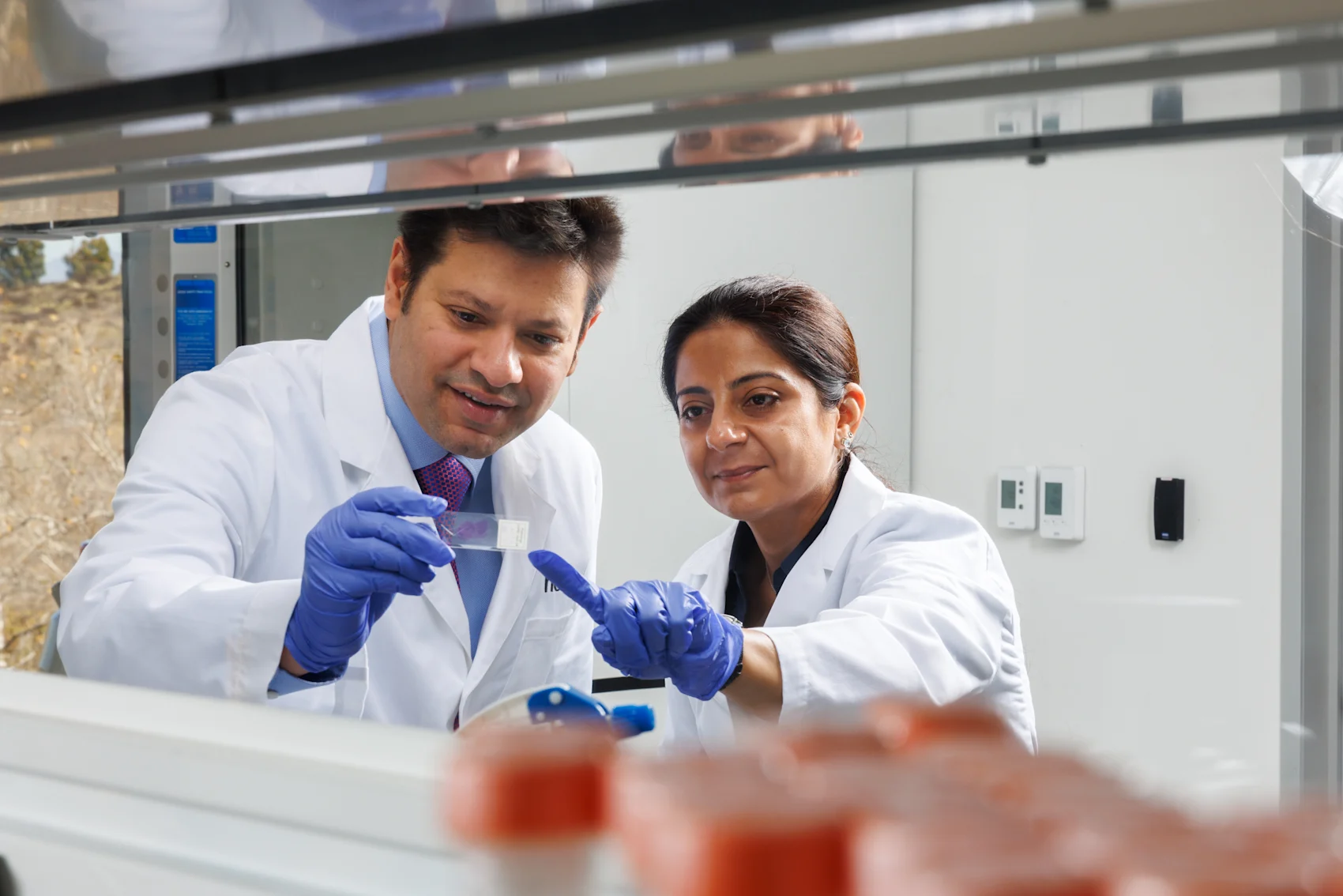
Led by Hoag's Dr. Rajan Gogna and Dr. Esha Madan, the research was published on November 10, 2026 in Nature Medicine.
HGSOC often forms in the fallopian tube as STIC, a group of abnormal cells that are microscopic, non-invasive, and invisible to imaging and conventional cancer blood tests. STIC is usually only discovered incidentally during surgery to remove the fallopian tubes and /or ovaries.
The study found elevated blood levels of Tu-Stroma in women with both STIC and early-stage HGSOC. Tu-Stroma is an RNA molecule associated with one of cancer’s most fundamental biological processes: weakening neighboring healthy cells to create space for cancer cell growth. By studying this earliest competition between cancer and healthy tissue, Hoag researchers identified a molecular warning signal that could potentially reveal cancer development years before conventional tests can detect a tumor. This discovery demonstrates how fundamental biological research can lead to entirely new approaches to early cancer detection.
“Ovarian cancer does not begin the day we discover a tumor. It often begins much earlier, with microscopic changes in the fallopian tubes that we can’t see during routine screenings,” said Dr. Gogna, Director of Translational Research at the Hoag Family Cancer Institute. “For decades, we have focused on finding smaller tumors. Then we asked a fundamentally different question: What if we could identify the earliest molecular warning signs before invasive cancer even develops?”
The details of the study
The eight-year, international, multi-institutional study, led by researchers at Hoag Family Cancer Institute, brought together scientists and clinical samples from multiple countries to develop and validate the blood test. In a separate group of women used to validate the findings, the test detected the precancerous condition (STIC) in 92.3% of women who had it and correctly identified 98.2% of healthy women. When researchers modeled how the test might perform in a high-risk population, they found that approximately 72% of positive results would be accurate, while a negative result would be correct nearly 100% of the time.
From discovery to prospective clinical validation
The study published today analyzed previously collected blood samples from women with confirmed diagnoses, establishing a promising new approach to detecting ovarian cancer at its earliest biological stages.
Building on this discovery, Hoag researchers are planning prospective clinical studies involving women from Hoag and the broader community, including those with and without elevated genetic risk of ovarian cancer. Researchers will collect blood samples and follow participants over time to determine how early the molecular signal can be detected, how reliably it identifies women with precursor disease, and whether it can ultimately help guide clinical decisions.
The long-term goal is to translate this discovery into a clinically validated blood test that could transform ovarian cancer surveillance and prevention.
“This groundbreaking research is a meaningful milestone for Hoag as well as for women and families affected by ovarian cancer,” said Dr. Steven Grossman, Grace E. Hoag Executive Medical Director Endowed Chair, Hoag Family Cancer Institute. “This work reflects our commitment to pushing the boundaries of cancer research and translating scientific discoveries into new possibilities for patients. It also reinforces Hoag’s growing national leadership in translational oncology and our ability to bring together the research, expertise and clinical care needed to move promising discoveries forward.”
Hoag’s translational research enterprise is supported by a multidisciplinary team of scientists and research professionals, including Drs. Gogna and Madan. This work is made possible, in part, by the generosity of philanthropic partners whose investments help advance cancer research and improve care for patients.
What this could mean for women
The potential impact of this research is especially meaningful for women with elevated genetic risk, including those with BRCA1 or BRCA2 mutations. Many women face difficult decisions about preventive surgery to remove their fallopian tubes and ovaries, sometimes before completing their families and at the cost of early menopause. If further studies validate the Tu-Stroma blood test for clinical use, it could one day give women and their physicians, whether or not there is a known risk of ovarian cancer, an important tool for informing decisions around evolving risk reduction and intervention strategies that could eliminate pre-cancerous STIC lesions long before they transform into ovarian cancer.
“For women at high risk, this could transform how we approach prevention,” said Dr. Madan, Principal Investigator and Group Leader of the Cell Competition in Tumor Microenvironment Laboratory at Hoag. “Today, decisions about preventive surgery are largely guided by inherited risk, without knowing whether precancerous lesions are actually present. Our discovery could eventually provide that missing biological information. But our vision extends beyond early detection. We are already working on innovative approaches aimed at stopping these microscopic lesions from progressing, potentially eliminating the need for preventive surgery altogether. Our ultimate goal is not simply to detect ovarian cancer earlier, but to prevent invasive cancer from ever developing.”
Learn more about the Hoag Family Cancer Institute.
Related Articles


Neuroscience
Hoag Recognized as a Center for Comprehensive MS Care by National MS Society- November 6, 2026 · 3 min read