Leading the future of foregut care
Expanding options for patients with esophageal and upper digestive disorders
Disorders of the esophagus and upper digestive tract rank among the most complex challenges in digestive health. Yet many people spend years living with chronic reflux, swallowing difficulties, or persistent indigestion, believing their symptoms are simply normal—or that nothing more can be done if medication doesn’t help.
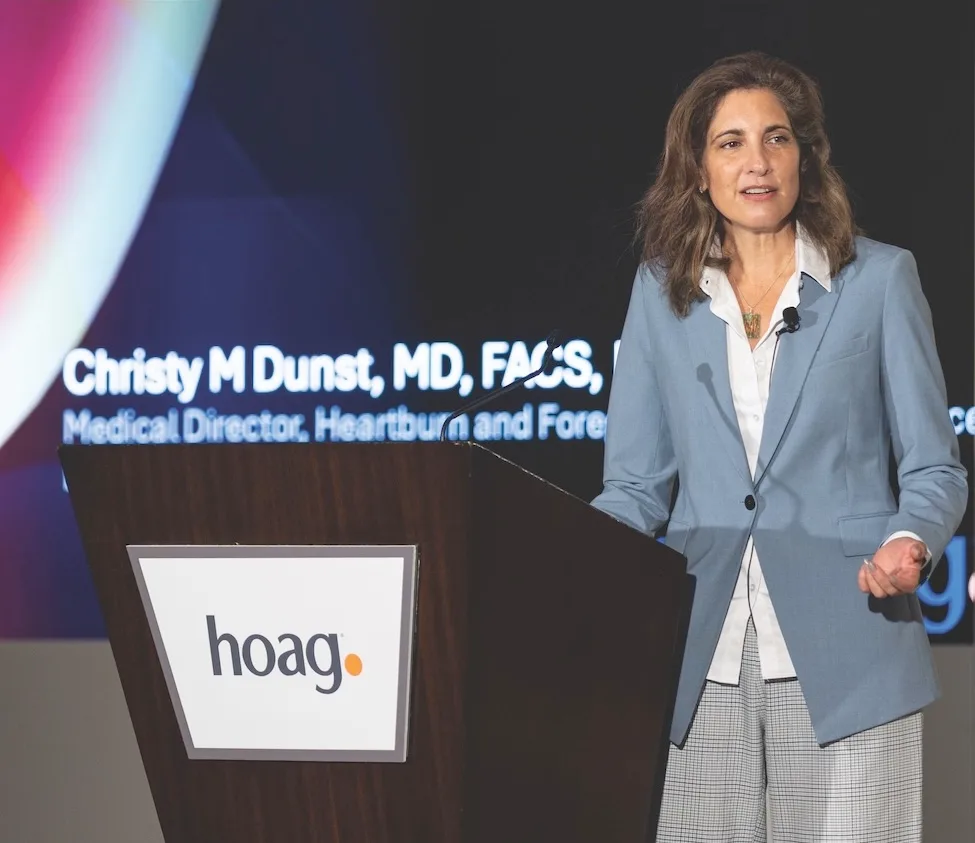
For Dr. Christy Dunst, chief of foregut surgery at Hoag’s Digestive Health Institute, helping patients understand they don’t have to live with those symptoms is often the first step toward better care.
While these conditions are frequently treatable, persistent symptoms can also be signs of more serious disease, including Barrett’s esophagus, the leading risk factor for esophageal cancer. Through education, advanced diagnostic testing, and expert evaluation, Dr. Dunst helps patients recognize when it’s time to seek care—and how many options they have.
“People think it’s normal to have troublesome heartburn, that swallowing trouble is just part of aging, or that if medication doesn’t help, there’s nothing else we can do. We have a lot of tricks up our sleeves.”
As leader of Hoag’s growing foregut program, Dr. Dunst specializes in diseases of the esophagus and stomach, treating everything from chronic reflux and swallowing disorders to Barrett’s esophagus and esophageal cancer.
But she sees her role as much more than treating disease.
Patients at Hoag’s Digestive Health Institute benefit from a multidisciplinary team that includes gastroenterologists, advanced endoscopists, foregut surgeons, radiologists, pathologists, nutrition specialists and nurse navigators working together to develop individualized treatment plans.
“My approach has always been to treat patients like family,” says Dr. Dunst, who is also president of the American Foregut Society. “My job is to educate them, help them understand what’s happening in their body, and give them a fair discussion of all the treatment options so they can make the decision that’s right for them.”
Dr. Dunst’s passion for foregut surgery began early in her training, when she watched a mentor calmly repair a life-threatening esophageal injury that had thrown an entire hospital team into motion. While others saw a crisis, she saw the confidence and expertise she hoped to one day bring to her own patients.
“I wanted to be that person. Someone who could take something that terrified everyone else and just fix it.”
Today, that same confidence and expertise shape Hoag’s approach to foregut care, from chronic reflux to some of the most complex esophageal procedures.
Each week at Hoag, foregut surgeons, neurogastroenterologists, advanced endoscopists, and nutrition specialists come together to review complex cases, considering the full spectrum of treatment options—from medical therapy and advanced endoscopic procedures to minimally invasive surgery—to develop a personalized care plan for each patient.
Earlier detection is also changing how foregut disease is diagnosed and treated.
Hoag recently introduced EsoGuard, an office-based DNA screening test that helps identify patients who may have Barrett’s esophagus before it progresses to cancer, giving physicians a chance to intervene earlier, often before more invasive treatment becomes necessary. It is part of a broader initiative to identify Barrett’s esophagus earlier, with the goal of reducing the number of patients who develop advanced esophageal cancer.
Looking ahead, Dr. Dunst sees advances in endoscopy and minimally invasive techniques moving the field toward a future with fewer, or in some cases no, external incisions.
Just as important, she believes that earlier diagnosis and intervention will help more patients receive treatment before their disease advances to the point where options are more limited. As Hoag continues expanding its foregut program, including future growth in Irvine, more Orange County patients will have access to a coordinated team delivering expert digestive care close to home.
Related Articles

Neuroscience
Hoag Recognized as a Center for Comprehensive MS Care by National MS Society- November 6, 2026 · 3 min read
Article
Advanced breast imaging technology delivers detection without compression- November 3, 2026 · 2 min read