Hoag’s Commitment to Innovation Creates New Paths for Parkinson’s Treatment
Parkinson’s disease creates limits. The progressive neurodegenerative disorder leads to tremors, rigidity and slow movements. It limits a person’s ability to walk up and down stairs, to hold utensils, to tie their shoes.
Hoag’s Pickup Family Neurosciences Institute is dedicated to removing those limits—to creating new paths to care that can help slow the progression of disease or even delay symptoms altogether.
“What is exciting at Hoag is that we are able to introduce Orange County to advanced technologies while they are still in development or in their early stages of use,” said Dr. Neal Hermanowicz, a Hoag neurologist. “Our focus is on making brain treatments less invasive, more precise, and potentially able to deliver drugs directly to affected areas of the brain.”
Hoag’s team envisions a world of excellence in which comprehensive care, including lifestyle modifications like exercise and nutrition, can slow disease and improve lives.
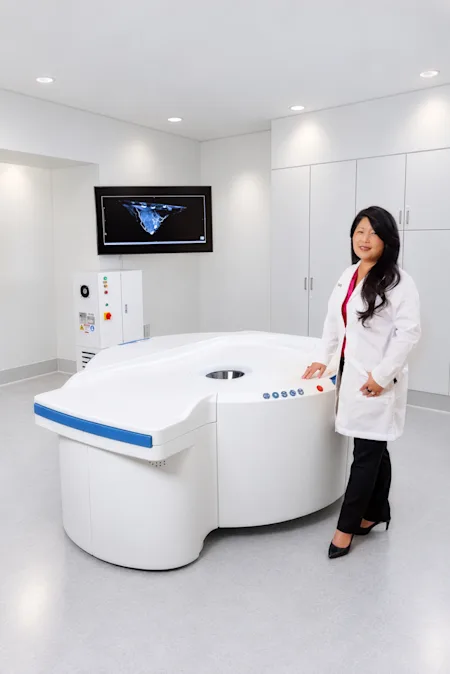
One of the most exciting technologies available at Hoag is Focused Ultrasound (FUS). This cutting-edge technology uses sound waves guided by MRI to target and treat the precise area of the brain responsible for tremors, offering a safe and effective alternative to invasive surgery. Early clinical trials found FUS led to at least 75% improvement in tremor severity for patients, even three years after treatment, with no significant side effects.
For patients whose essential tremor or tremor-dominant Parkinson’s disease has not responded to medication, focused ultrasound offers an advanced, incisionless treatment option. Treatment starts with low energy, which is gradually increased as the patient responds to create a small therapeutic lesion that improves a patient’s tremors.
“This could be transformative not only for Parkinson’s disease, but for other brain conditions,” Dr. Hermanowicz said.
As Hoag innovates, it continues to lead in proven technologies and techniques for Parkinson’s, including Deep Brain Stimulation (DBS). While DBS is not new, Hoag is renowned for this important surgical intervention. During the surgery, electrodes are inserted into specifically targeted areas of the brain that are identified using imaging. These electrodes are then attached to an implantable pulse generator (IPG) or battery placed below the collarbone. The IPG sends electrical impulses to the brain to override movement symptoms that cause problems. This is similar to a pacemaker device that treats heart rhythm disturbances. While not a cure, this treatment greatly reduces the movement disorders associated with Parkinson’s disease in many patients.
“DBS can be a game changer for patients who have been diagnosed with tremor-dominant Parkinson’s, as well as those who experience stiffness and pain associated with their condition,” said Dr. Hermanowicz, who is among several preeminent experts in DBS at Hoag.
Learn more about the Salsbury Family Movement Disorders Program.
Related Articles


Article
How breast imaging is evolving to support more personalized care- October 19, 2026 · 4 min read