Guided by expertise: Hoag’s team-based approach to prostate cancer care

A prostate cancer diagnosis brings complex decisions. For many patients, the challenge isn’t a lack of options; instead, it’s understanding which option is right for them.
At Hoag, innovation in prostate cancer care is defined by choice. As a privademic health system, Hoag combines the personalized approach of private medicine with the research rigor, advanced technology and multidisciplinary collaboration more often associated with academic centers.
The result is a comprehensive program that offers the full spectrum of diagnostic and treatment options, guided by teams that help patients navigate decisions with clarity and confidence.
At Hoag, urologic oncologists work closely with radiation oncologists, medical oncologists, radiologists, pathologists, and advanced imaging specialists, reviewing each case together to ensure every treatment recommendation reflects both clinical expertise and the patient’s goals.
“Prostate cancer is unique because there are often multiple appropriate treatment paths,” says Dr. Robert Torrey, Co-Medical Director, Urologic Oncology, who serves alongside Dr. Jeffrey Bassett, the Benjamin & Carmela Du Endowed Chair in Urologic Oncology, Co-Medical Director, Urologic Oncology. “Our responsibility is to ensure patients truly understand their options—and that every option is available to them.”
Hoag is one of the few centers in the region to offer all major prostate cancer treatment modalities within one coordinated program. Routine surgical options at Hoag include the most advanced minimally invasive approaches, such as single-port (SP) robotic surgery and high-intensity focused ultrasound (HIFU); transperineal prostate biopsies employing fused MRI/ultrasound guidance for improved safety and accuracy; and specialized services for higher-risk prostate cancer patients.
Surgical innovation at Hoag continues to advance with the introduction of haptic-enabled robotic technology, which restores a sense of touch during prostate cancer surgery. For patients, this matters because preserving urinary and sexual function is often one of the greatest concerns after treatment. By allowing surgeons to better feel tissue boundaries and subtle differences in anatomy, this technology supports more precise dissection around critical nerves and structures—helping remove cancer effectively while reducing the risk of unintended injury that can impact quality of life after surgery.
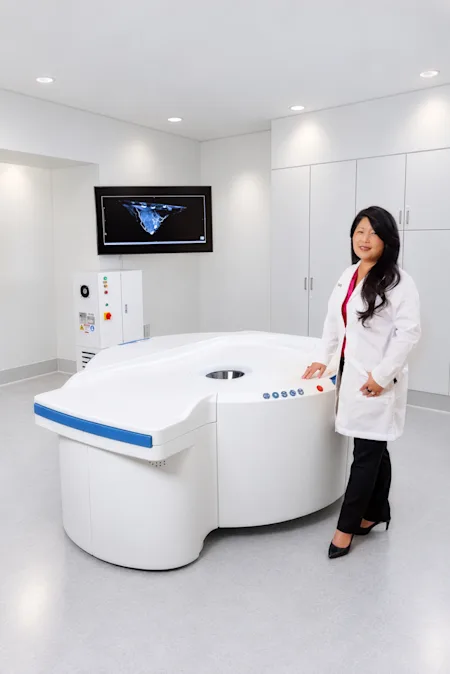
Complementing surgical approaches, radiation therapy is a key treatment modality for many patients with prostate cancer. Hoag’s ViewRay MRIdian system allows physicians to visualize tumors using MRI imaging before and during radiation treatment—a capability available at only about 40 sites worldwide and supported by one of the most experienced radiation oncology teams in Southern California. As the most advanced imaging and treatment modality for stereotactic body radiation therapy, the ViewRay MRIdian allows Hoag to treat most prostate cancers in five treatment fractions.
“This level of imaging precision allows us to adapt treatment in real time,” says Dr. Craig Cox, Medical Director of Radiation Oncology at Hoag. “It gives us confidence that we’re targeting the cancer while protecting surrounding healthy tissue.”
Beyond surgery and radiation, Hoag’s molecular imaging and systemic therapy programs provide advanced options for patients with more complex or metastatic disease.
“In prostate cancer, innovation isn’t just about the device we use,” says Dr. Rafi Ahmed, a urologic cancer medical oncologist who, with colleague Dr. David Benjamin, treats patients at Hoag. “It’s about how we integrate imaging, biomarkers, and systemic therapy to personalize care. When our teams collaborate from the beginning, we can tailor treatment to the biology of the disease and the goals of the patient.”
With support from generous donors, innovation in prostate cancer care at Hoag extends across the patient journey to include next-generation biomarker-based screening strategies. This program helps identify patients with higher-risk disease who may benefit from earlier intervention, while allowing others with low-risk cancer to be safely observed without unnecessary treatment.
Throughout the process, Hoag patients remain active participants in their care. Physicians collaborate closely across urology, radiation oncology, medical oncology, imaging, and pathology to review each case together, ensuring recommendations reflect both clinical insight and patient priorities.
“At Hoag, innovation isn’t something we adopt once. It’s something we continuously build,” says Dr. Kevin Lin, radiation oncologist at Hoag. “Our privademic model allows us to bring new technologies and research directly to patients, while keeping care personal, coordinated, and centered on what matters most to them.”
Related Articles


Article
How breast imaging is evolving to support more personalized care- October 19, 2026 · 4 min read